
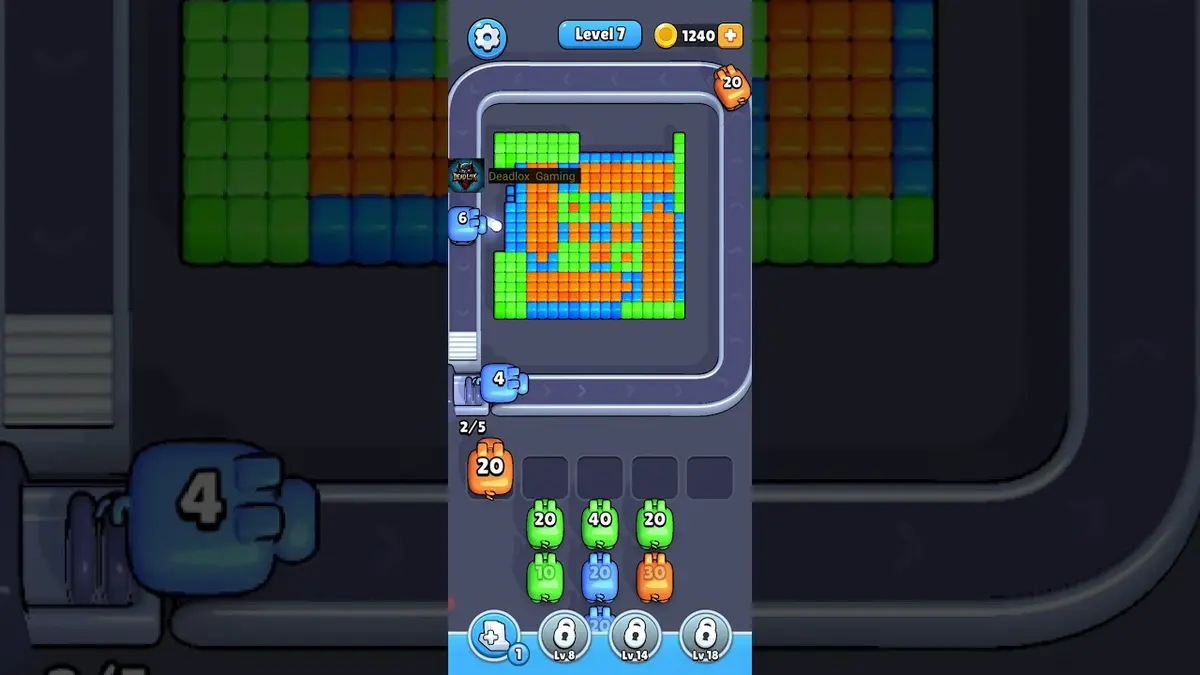

A full tray is a loss, not a warning
There is no penalty phase. If the sixth pig has nowhere to go, the run ends. Play as if four slots is the real limit and the fifth is an emergency exit.
Beginner guide
Tap a pig whose colour can already reach visible pixels, let it spend its shots, and keep the five-slot tray open for the colour that opens the next part of the board. That is the whole game — the rest is deciding which colour earns your next move.
The loop
Every Pixel Flow move is one of these five decisions. Runs that end early usually skip step four.
A pig only helps when pixels of its colour are already exposed. Sending one into a sealed area burns the shot and takes a slot without changing the board.
The pig leaves after its shots run out. What matters is not the damage but the shape it leaves behind: a connected group that clears cleanly beats a ragged edge every time.
Five slots are the whole safety net. The moment the tray is full you are no longer choosing moves, you are reacting to whatever the conveyor sends next.
The best opener removes a group that unlocks a second region. A colour you can clear in one tap but that changes nothing is usually the wrong first move.
Add Tray, Hand, Shuffle and Super Shooter each fix one specific failure. Spending one before you can name the failure is the most common way a good run ends.
Tray rules
Most guides talk about colours. The tray is what actually ends runs, so learn these three rules before you chase a route.
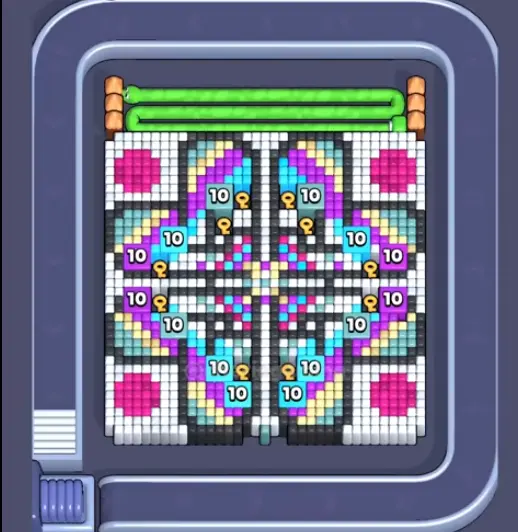
There is no penalty phase. If the sixth pig has nowhere to go, the run ends. Play as if four slots is the real limit and the fifth is an emergency exit.
A pig whose colour is not exposed anywhere is a slot you cannot use yet. Before accepting, find the pixels it will hit on this board, not on a board you remember.
Opening a new region is only good if you can clear it soon. Opening three colours at once spreads your shots thin and fills the tray with half-finished groups.
Boosters
Each power-up fixes a different failure. If you cannot name which one you have, the booster is guessing for you.

Saving a run when two useful pigs are about to arrive but the five slots are already tight.

Removing one wrong pig so the real opener can enter the tray.

Recovering a matching board where you know the next needed color and the belt will not serve it.

Pushing through a large blocker after you confirm it is the real route opener.
The full decision tree — including when to save instead of spend — is on thePixel Flow power ups guide.
When you get stuck
Playing is the point. These are only for the moment the board stops making sense.
Questions
Tap a pig when pixels of its colour are visible on the board. It fires its shots, clears matching pixels and leaves. Keep at least one of the five tray slots free, clear the colour group that opens new space, and only spend a booster once you can name the blocker it removes.
The run ends when a pig has nowhere to go. The tray holds five pigs, so treat four as your working limit and the fifth slot as an emergency exit rather than storage.
Yes. It runs in the browser with no download, and this site also publishes the level index, the screenshot solver and the power-up guide so you can keep playing when a board stalls.
Find the largest exposed colour group whose clear opens a second region of the board, and spend that colour first. Clearing a colour that changes nothing visible is the usual reason a run stalls two moves later.
A level number can be reused with a different layout, and from Level 1,851 the published preview is a randomized-pattern card rather than a fixed board. Check the picture before following a route, or match a screenshot instead.
This site documents 2020 boards, from Level 1 to Level 2020. The level count page explains where fixed layouts end and what to do above that range.